
CONTENTS
Complete Guide On How To Choose A Backpacking Pack
Explore the CabinZero ADV Collection
View All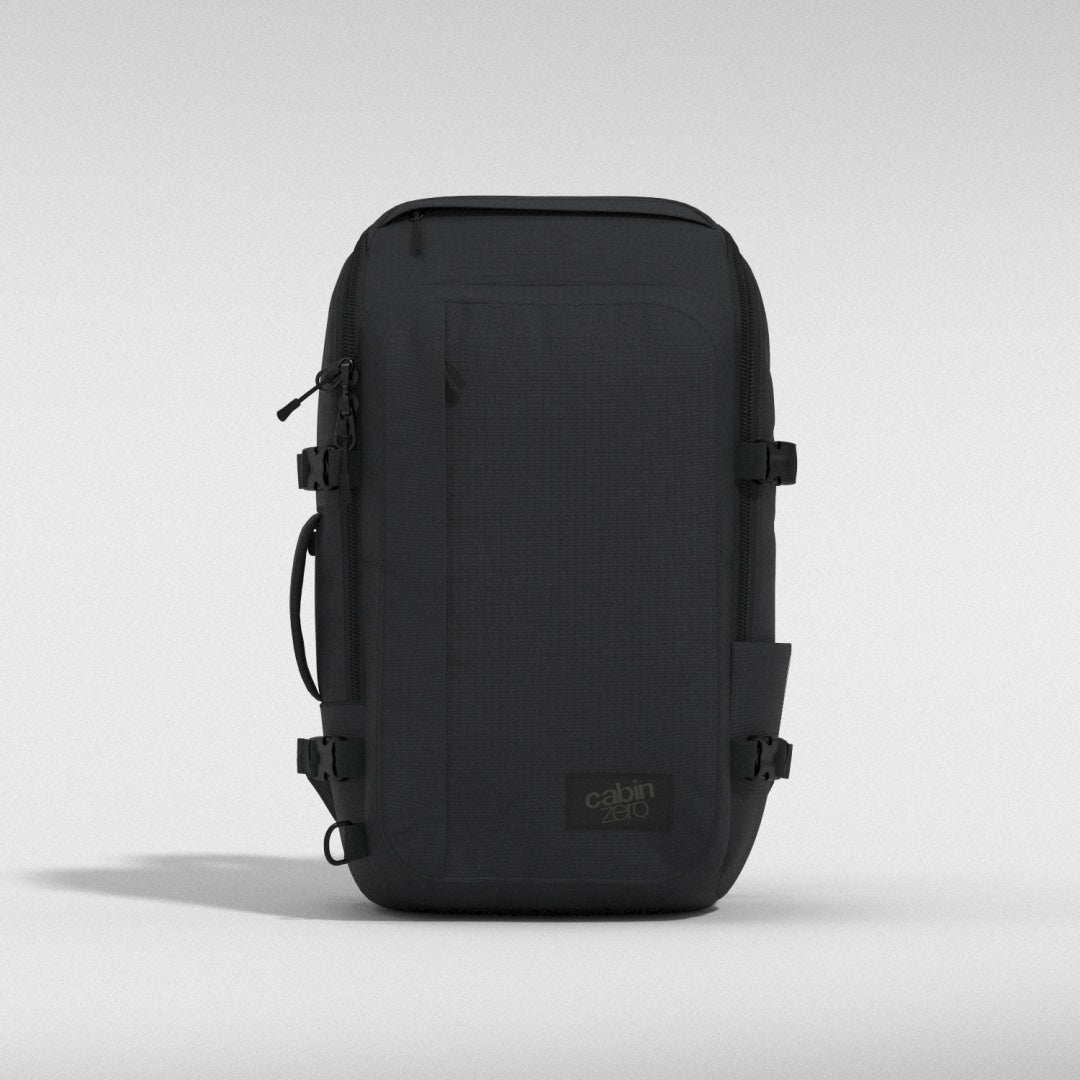


How to choose your backpacking pack is more important than you think. It’s probably more than an art that a newbie backpacker would give it credit for.
Plenty of travellers debate between getting bulky backpacks that can power them through anything, like a multi-day hike through the Peak District, or the ones that look pretty for photos. Smart travellers prefer backpacks that can deliver both, and some!
From finding the fit, purpose, and capacity to design, if you get it right from the get-go, with CabinZero’s assistance, you are already a few big steps closer to a hassle-free trip.
We also help you break down the specifications and provide the best recommendations - for example, CabinZero’s daypacks for a day hike or tactical packs for solo travelling - to make browsing easier.
-
How does it fit you.
-
How much will you bring.
-
Pay attention to features.
-
Test drive it.

Choose your pack right from size to capacity to features with CabinZero.
Step 1: Get the Perfect Fit (This is Non-Negotiable)
The first lesson on how to choose your backpacking pack will always start with the fit.
Before we get to the what and the how, let’s look at the why. Why does the fit matter?
-
A backpack will follow you mostly anywhere, most of your trip; for example, up the mountain, at the busy airport or in the middle of a crowded attraction.
-
A poor fit will result in an aching back, sore shoulders and disorganisation of your stuff.
-
Such discomforts will soon take your attention away from enjoying your trip and leave you having to adjust your backpack all the time.
In other words, a perfect fit backpack lets you enjoy your journey to the fullest. Here’s how to get the perfect backpack fit.
Measure Your Torso Length

For ultra comfort, backpacks should not exceed your torso length.
There are plenty of creative ideas on how to measure your torso length for a backpack. Some just require a good friend, a mirror, and a bit of careful eyeballing. Some actually are more methodological yet still fairly easy to do at home.
You will need a measuring tape. If you don’t have one, you can use a string, a long shoelace, or a ribbon and a marker.
The distance between the C7 vertebra and your iliac crest should be your torso length.
- First, tilt your head forward and down. Feel along the nape with your fingers for the highest bump, which is also known as the C7 vertebra. This is where the top of your backpack should be - not higher or way too low.
- Second, ask a friend to measure from this point down towards your iliac crest. To define your iliac crest, place your hands on your hips and feel with your thumbs where the highest points of your hip bone sit on both sides of your body.
- Draw a line between them. Similar to the top of the backpack, the bottom of it should not cross this line.
Understanding Hip Belt Sizing
Gravity will do its thing, regardless. Therefore, without a hip belt and one in a proper size at that, as you wear a backpack for a long period of time, your shoulders will automatically take the load.
To get your hip belt sizing, wrap a measuring tape around your hips, just above the iliac crest.
Ideally, if your measurement is the maximum the belt can accommodate, you should size up.
CabinZero’s note: If you have a tilting posture, for example, an anterior pelvic tilt that tends to extend your belly forward when you rest, look for a backpack fit that is wider vertically.
Do You Need a Women's-Specific Pack?

Women’s specific packs exist, but a great pack fit does not have to be gender specific.
It depends on where your struggles lie. Some women who have smaller chests find men’s backpacks with the traditional J-straps more comfortable.
Some have the opposite issue with the straps being too snug and causing chafing, and go for backpacks with S-straps.
A sternum strap (chest strap) is also something that makes a backpack work for ladies, especially with a hiking backpack for women or a mountaineering backpack that carries a much heavier load.
A sternum strap helps share the weight with your shoulders and keeps the straps from sliding off them. For women, a well fit women’s-specific pack should have a sternum strap sitting higher than your bust, where it’s flatter, rather than across.
Generally, when selecting the right backpack, regardless of gender, the pack should fit your anatomy and your needs.
Step 2: Choose Your Pack's Capacity (How Big Should It Be?)

Consider how much you will bring.
Another factor in choosing a backpacking pack for you is capacity.
You need to think about how much stuff you will bring and then choose bag that fits it. Don’t do it the other way around: buy a big bag and fill it up later.
To choose capacity, you’ll need to think about two things: how many days you will be travelling and how much you should pack, given the days.
Here’s a walkthrough based on trip lengths.
Weekend (1-3 nights): 30-50 Litres
A 30L to 50L pack usually measures around 45 - 60 cm in height, 25 - 35 cm in width, and 20 - 30 cm in depth (with slight differences depending on brands).
This capacity is perfect for short trips such as day hikes and weekend trips. A pack this size can easily handle two sets of clothes, a quart-sized bag of travel toiletries, and some lightweight accessories.
A 30L - 50L backpack is also the common size for most airlines’ carry-on travel backpack standards. So, if you want to save some money on baggage, this capacity is perfect.
Multi-day (3-5 nights): 50-70 Litres
This is a popular range for backpackers. A 50L - 70L backpack typically measures around 60 - 80 cm in height, 30 - 40 cm in width, and 25 - 35 cm in depth.
If you pack smart, you can definitely carry a 50L - 70L backpack for a week-long trip, especially if it’s a city trip with laundry stops and nice weather.
How does a 30L - 50L capacity feel compared to a 50L - 70L? Let’s take 40L and 60L, for example. Other than how much you can pack, a 40L vs a 60L also differs in how it feels physically. A 40L tends to look more compact and close to your body, whilst the 60L extends vertically and oftentimes horizontally too.
Extended Trip (5+ nights): 70+ Litres
A 70L is typically 70 - 90 cm tall, 35 - 45 cm wide, and 25 - 40 cm deep. In this territory, we’re talking about weeks-long trips to full-on expeditions.
Packs in this size aren’t just big for the sake of it; they tend to come with specialised features. For example, a sleeping part compartment and unique gear attachments.
Step 3: Understand the Key Features (The Bells & Whistles)
Now that you know how to choose a backpacking pack by the fit and the capacity, let’s look at the features. Understanding the features helps narrow down your list of ideal backpacks.
Frame Type

The CabinZero ADV 42L has a removable aluminium frame sheet.
Most backpacks have either internal frames, external frames, or are frameless.
-
Internal framed backpacks are rigid and have a “shape”, but you cannot see the structure.
-
External framed backpacks, like the name, have the suspension system visible on the outside.
-
Frameless backpacks are shaped as you pack. Therefore, with a frameless one, you have to pack smart, but the biggest advantage is that it’s the most lightweight option.
|
Frame type |
Pros |
Cons |
|
Internal |
|
|
|
Frameless |
|
|
|
External |
|
|
Ventilation
Good ventilation can come from the rear panel and its materials. Well-designed ventilation systems will allow air flow.
Generally, mesh panels are great for backpacking in hot regions, such as Southeast Asia. They help air circulate and create space for sweat to escape.
Padded panels are found in more daily-use backpacks made for short commutes and 1–2-day trips with minimal activities.
Pack Access
Front-loading backpacks allow you to pack like a suitcase. A top-loading backpack is the traditional pack-from-the-top kind.
|
Pros |
Cons |
|
|
Front-loading |
|
|
|
Top-loading |
|
|
Pockets And Straps

Well-thought-out compartments and pockets can improve packing.
Good backpack straps should have layers - or padding - instead of one raw piece of material.
They should be wide enough that, when you load your backpack, the straps pull slightly but don’t dig into your skin.
You’ll typically find three main types of straps on a backpacking pack:
-
Shoulder straps.
-
A sternum strap.
-
A hip belt.
A good backpacking pack will also come with compression straps, which squeeze the pack tighter to be more compact.
When it comes to pockets, you don’t have to have too many. In point of fact, you will only need one main compartment, two or three smaller ones for smaller items, and a quick-access secure pocket for important items like a passport, a phone, and IDs.
If you’re backpacking as a digital nomad, you’d need to look for a backpacking pack with a dedicated pocket for your laptop.
Step 4: How to Test a Pack (The Final Check)
What makes a good backpack does not stop at getting the fit and the parts right, but also how it actually feels altogether with weight, movement, and time. To test your pack, follow these three steps.
Add Weight
The best tip to calculate your load is to adhere to the 20% rule of backpacking. Your pack should weigh no more than 20% of your body weight.
For example, if you weigh 70 kg, then your load should be 14 kg or less. For a short trip with plenty of rest stops, you can go a bit overboard.
Try packing with your actual items and gear to get a realistic feel for where things should be. If you haven’t assembled your packing list yet, use water bottles and books to simulate the load.
Walk around
Once you add weight to your pack, it’s time to try moving around with your backpack. Don’t just walk in a straight line. Get some movements in, such as climbing the stairs and bending down to pick things up.
As you move around, ask yourself: if your items are sliding around or staying in place, should your straps be longer, and if there is anything tugging you where it shouldn’t be.
Wear It For Some Time
Most issues don’t kick in until a few hours into the journey, so don’t drop your pack just yet. Keep it on for about 15 minutes or even longer if you can.
Many backpackers share that some backpacking packs need to be broken in, similarly to how a pair of jeans doesn’t feel comfortable unless they have been through the wash a couple of times.
Thus, if you wear them for some time a day up until your journey, the fabric will have time to soften up and mould to your body better.
Whilst wearing and walking, try to feel and visualise where and how it is uncomfortable. See if the hip belt and shoulder straps make you comfortable.
How To Choose A Backpacking Pack With Cabinzero
How to choose a backpack pack should start with the fit. Surprisingly, it’s not as challenging as you think. Think about where the weight will need support - the shoulders, the back, the hip, and the chest. These are the points where the measurements should fit your body the best.
Then it comes to picking the capacity. Think about the length of your trip and your packing list.
To narrow down the list of backpacks that already fit you and your load, look at their features. Depending on how you actually travel (city-hopping or wilderness expedition), your backpack should have the right built-in features, such as the frame types, ventilation system, and organisation.
CabinZero daypacks are made for the perfect middle ground between travel and day-to-day use. You can carry a daypack for a short hike, a staycation, or a simple weekend trip, ranging from 26L to 36L and 44L.
It can also be a great beginner pack when you’re building your bigger collection or a companion pack that carries the lighter load when you don’t need to carry your entire load.
And That’s All From Us For Now
Found your backpacking pack? For more guides on backpacks, destination exploration, and travel tips, hop on our social media or blog posts!
Nguyen Tran Gia Khanh


Leave a comment